In this LAB note
Question · Hypothesis · Method · Results · What Failed · What We Learned · What Changed at MOMS
Question
Two of our shakes land 2.5 calories apart. We call one Light and the other Filling. What is that label measuring?
Hypothesis
Our recipe database carries a field called Cal Label, and every one of the 201 recipes gets one of four values: Light, Standard, Filling, or Meal Replacement. We assumed this was a calorie band - that Light meant fewer calories and Meal Replacement meant more, with Standard and Filling stacked in between. We expected the four groups to separate cleanly on calories, and we expected the distance between a Light shake and a Filling shake to be large enough that a customer choosing between them would be choosing a meaningfully different amount of energy.
Method
Published research. Bell and colleagues gave 18 normal-weight women free access to a main entree manipulated for energy density - low, medium, or high - while holding fat content and palatability constant across conditions. The women ate a similar amount of food by weight in all three conditions. Because the food weighed the same but carried different energy, intake came out at 1800 +/- 86 kcal on the high-energy-density entree, 1519 +/- 67 kcal on the medium, and 1376 +/- 43 kcal on the low. Rolls, Bell and Thorwart then tested whether the water has to be inside the food. Twenty-four lean women received one of three isoenergetic 1128 kJ preloads 17 minutes before lunch: a chicken rice casserole, the same casserole served with a 356 g glass of water, or a chicken rice soup containing the same ingredients in the same amounts as the casserole that was served with water. Energy intake at lunch was 1209 +/- 125 kJ after the soup, against 1657 +/- 148 kJ after the casserole with water and 1639 +/- 148 kJ after the casserole alone. Blending the water in worked. Drinking it alongside did not. Internal analysis. We grouped all 201 recipes in the MOMS database by their Cal Label and compared calories across the four groups. We then summed the stated weight of every ingredient in each recipe across all six slots - Liquid, Body, Fruit & Vegetable, Protein, Functional, Flavor - treating 1 ml of liquid as 1 g, to get a charged weight per shake, and divided calories by that weight to get an energy density in kcal per gram. Finally we pulled matched pairs: recipes carrying different Cal Labels that land within 3 calories of each other.
Results
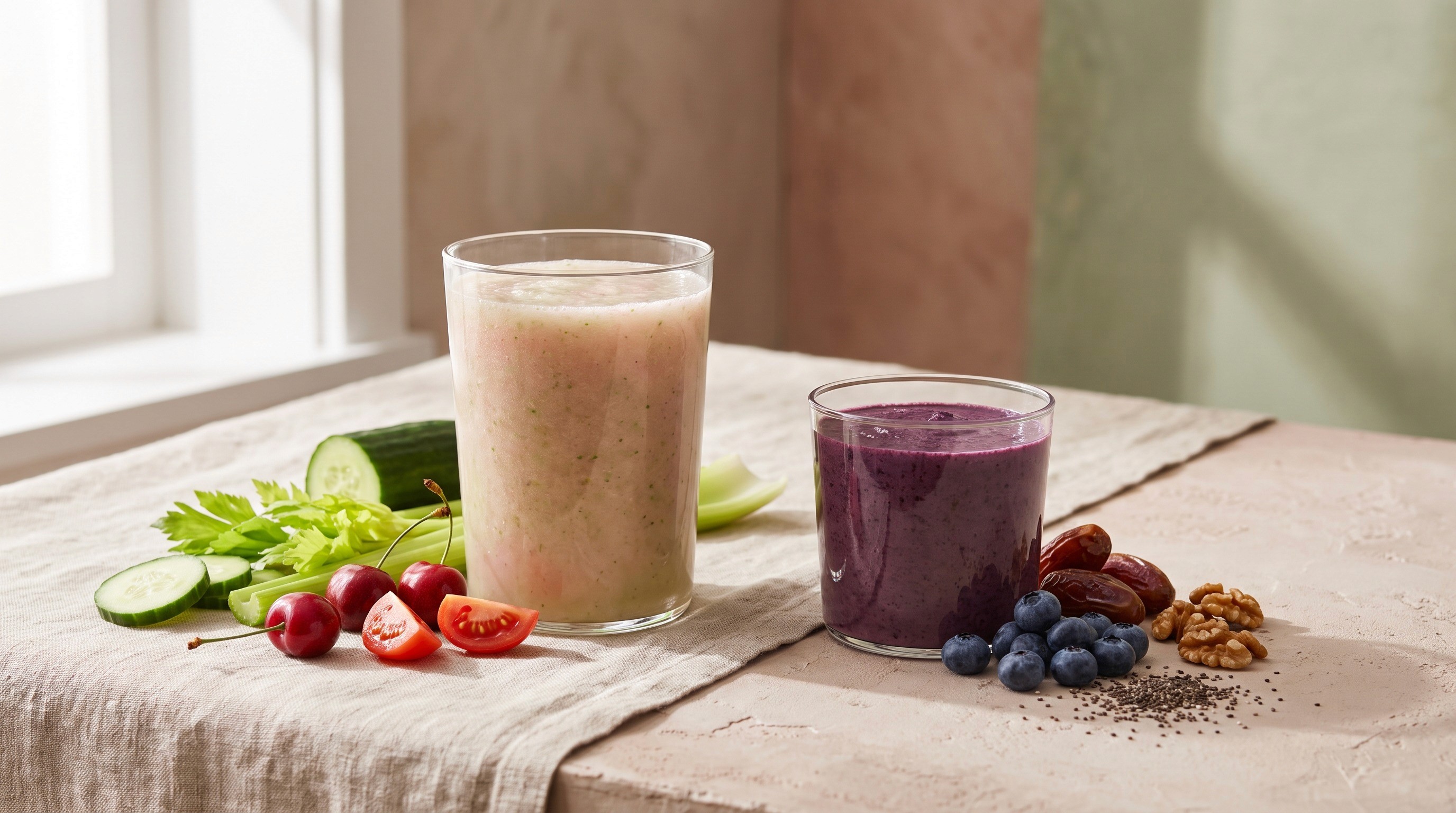
The four labels barely separate on calories. Light averages 358.7 kcal (n = 45), Standard 373.8 (n = 77), Filling 384.2 (n = 65), Meal Replacement 391.0 (n = 14). The entire taxonomy spans 32.3 calories from end to end. Light to Filling is 25.5. The spread inside each label is larger than the spread between them. Light alone runs 296.3 to 398.1 kcal, standard deviation 32.3. Filling runs 270.5 to 399.9, standard deviation 20.7. A Light shake's calorie count varies more from one Light shake to the next than the average Light shake differs from the average Filling shake. What does move is weight. Light shakes average 657 g of charged ingredients; Filling shakes average 551 g. The label that sounds smaller is 106 g heavier. Most of that difference is liquid: 271 ml in the average Light shake against 197 ml in the average Filling shake. Which means the labels are sorting by energy density. Light averages 0.556 kcal/g, Standard 0.634, Filling 0.740, Meal Replacement 0.744. Ranked Light through Meal Replacement, the label correlates +0.442 with energy density and -0.446 with liquid volume, against +0.374 with calories, +0.157 with fiber, and -0.155 with protein. Water is the strongest single thing the label tracks. The matched pair makes it concrete. MY-W2-DETOX-004-V1 "Fresh Flow" is labeled Light: Coconut Water 150 ml + Rice Milk 150 ml, Cherry 74.8 g + Cucumber 77.5 g + Celery 50 g + Tomato 62.5 g, Tofu 50 g + Egg White 195 g, Turmeric 0.6 g, Maple Syrup 10 g. That is 820 g of ingredients at 378.2 kcal, or 0.46 kcal/g. WAI-W3-NUTR-009-V1 "Glow Recharge" is labeled Filling: Soy Milk 150 ml, Blueberry 35 g + Dates 12.5 g, Chicken 90 g, Flaxseed 4 g + Walnut 6.3 g + Chia Seeds 12.5 g, Honey 1.5 g. That is 312 g at 380.7 kcal, or 1.22 kcal/g. Two and a half calories apart. Five hundred and eight grams apart. The Light one carries 2.6 times the weight at 0.38 times the energy density. Read against Bell and Rolls, that ordering runs backwards. If people eat to a roughly constant weight of food, the 820 g shake we call Light is the one better placed to reduce what comes after it, and the 312 g shake we call Filling is the one that leaves the most room.
What Failed
The Filling label breaks its own rule at the bottom. EY-W2-DETOX-006-V1 "Airy Cleanse" - Almond Milk 300 ml, Pumpkin 65 g + Oatmeal 35 g, Carrot 50 g, Egg 27.5 g + Egg White 220 g, Agave 5 g - is labeled Filling and is the lowest-calorie recipe in the entire database at 270.5 kcal. It weighs 703 g, which puts it at 0.38 kcal/g, more dilute than the average Light shake and the most dilute of the four recipes in this note. If the label sorted cleanly by density, this one is filed in the wrong drawer. It is not alone. Seven of the 65 Filling recipes are less energy-dense than the average Light recipe. And MY-W3-GUT-003-V1 "Steady Ground" is labeled Light at 398.1 kcal - 17.4 calories more than the Filling shake we just compared it against, and within 1.8 calories of the highest-energy recipe we make. The label does correlate with calories, and we want to be exact about this. A rank correlation of +0.374 is a real relationship, not noise, and Meal Replacement genuinely does sit at the top of the calorie range with the tightest spread of any group: 366.2 to 399.4, standard deviation 9.0. The finding is not that the label is unrelated to calories. It is that the calorie effect is small - 25.5 calories between Light and Filling - and smaller than the variation inside either group. Our Score does not encode any of this. Across 201 recipes, Score correlates +0.21 with energy density, +0.02 with calories, and -0.25 with charged weight. "Fresh Flow" scores 16 and "Glow Recharge" scores 14, but "Airy Cleanse," the recipe that breaks the pattern, scores 15 - sitting right between them. Nothing in our internal Score is tracking the thing this note is about, and we are not going to imply that it is. Our weight figure is a charged weight, not a finished volume. Every recipe in the database is recorded as a 16 oz serving, and 820 g of ingredients does not fit in a 473 ml cup. Produce loses volume when it is blended, some is lost to the jar, and several recipes are clearly built to a yield rather than to a sum. So we can compare recipes against each other on charged weight, but we cannot claim that two shakes arrive in front of a customer at different volumes. That is the measurement we do not have. And neither study is a shake study. Bell measured ad-libitum intake of an entree over two days; Rolls measured a preload followed by a test lunch. Both used small laboratory samples of women, 18 and 24. Neither tested a 16 oz blended breakfast in someone's kitchen, and neither tested whether a customer who drinks the entire shake either way experiences any of this at all.
What We Learned
Cal Label is not a calorie band. It is closer to a density band, and mostly it is a water band. That is not a defect by itself. Density is arguably the more useful variable, because once the energy target is fixed near 400 the thing still available to move is how much volume that energy arrives in. But the name promises a calorie difference the numbers do not deliver. A customer who reads "Light" and expects to save meaningful calories is reading the wrong field: everything we make lands between 270.5 and 399.9 kcal, and the label barely narrows that band. The direction is worth saying out loud too. Our most dilute shakes are the ones we call Light, and our densest are the ones we call Filling. If the satiety literature transfers to a blended 16 oz shake at all, those two words describe close to the opposite of what each shake is likely to do to the next meal.
What Changed at MOMS
We are splitting the field in two. Cal Label stops carrying two jobs at once. Every recipe now gets a stated energy figure, which is the calorie number and nothing else, and separately a density tier computed as calories divided by charged weight, with thresholds taken from the distribution we measured today: under 0.55 kcal/g, 0.55 to 0.70, and above 0.70. We added a build-sheet check for the case that caught us. Any recipe whose Cal Label ranks it as more filling than its computed density tier gets flagged before it ships, because it means the label and the formulation are pointing in opposite directions. "Airy Cleanse" is the recipe that taught us to look. And we changed the first move when a recipe comes in over its energy target. The old move was to cut a dense ingredient. The new one is to add water-bearing volume first - the cucumber, celery and tomato in "Fresh Flow" are 190 g of produce carrying very little energy - and to cut only if that fails. Rolls is specific on this point: the water has to be blended in. Handing someone a glass of water next to the shake did nothing.
References
Bell EA, Castellanos VH, Pelkman CL, Thorwart ML, Rolls BJ. Energy density of foods affects energy intake in normal-weight women. American Journal of Clinical Nutrition, 67(3):412-420, 1998. | Rolls BJ, Bell EA, Thorwart ML. Water incorporated into a food but not served with a food decreases energy intake in lean women. American Journal of Clinical Nutrition, 70(4):448-455, 1999.
Keep reading
Previous experiment
Not sure which shake fits you? We match the formulation to your body type.
Find your body type